
DECaDE – The UKRI Centre for the Decentralised Digital Economy – has welcomed the publication of the House of Lords Communications and Digital Committee’s report on AI, copyright and the creative industries, following its contribution to the inquiry through expert evidence and research on media provenance.
The newly published report cites DECaDE’s multi-year work on provenance infrastructure, including the Time to ACCCT report co-authored with the CoSTAR National Lab, as well as DECaDE’s research on the use of open standards, such as the Content ARCs framework, as the technical foundations needed to support creator rights in the age of generative AI.
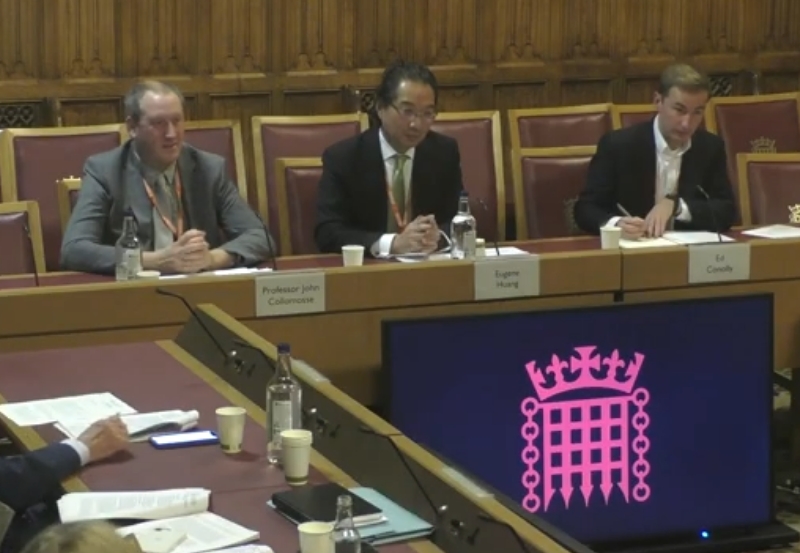
The report follows evidence given to the Committee by DECaDE Director Professor John Collomosse in December 2025, where he described the AI–copyright challenge as fundamentally a “content supply chain problem” and argued that the solution lies in strengthening the digital infrastructure through which content moves online.
A central focus of both the inquiry and DECaDE’s evidence was the role of open standards for media provenance, particularly frameworks such as the Coalition for Content Provenance and Authenticity (C2PA). These standards are designed to ensure that key information about authorship, ownership and usage rights remains attached to digital content as it is shared, reused and incorporated into AI systems.
The report also highlighted the work Professor Collomosse led on the three pillars of provenance — metadata, watermarking and fingerprinting — as essential mechanisms for enabling transparency and traceability at internet scale. Professor Collomosse commented;
“The inquiry’s report rightly highlights a critical gap in how creators are recognised and rewarded in AI systems—one our work at DECaDE has been tackling through multi-year research on media provenance. Our open standards contributions as well as our platforms, including EKILA, DECORAIT, ORAGen and ZOETROPE, demonstrate that a decentralized, creator-first AI economy is not only possible, but within reach.”
The House of Lords report examines how regulation, technical infrastructure and licensing models may need to evolve in response to the rapid growth of generative AI, with particular attention to how the rights of creators can be protected and enforced.
For DECaDE, the report’s recognition of provenance research marks an important step in the wider national conversation around responsible AI and the future of the creative economy and reinforces the growing view that provenance infrastructure will be a cornerstone of trustworthy and creator-centred AI ecosystems.
The Government has most recently published its own report on the issue, and has engaged extensively with DECaDE researchers and a wide range of other stakeholders in its production, stating that they no longer have a preferred option regarding a copyright exception with an opt-out model, and looks to potential licensing models including those enabled by media provenance. Further consultation on copyright reform will be needed to further map this ecosystem and ensure that any future decision aligns with the broader interests of the economy and UK citizens.
DECaDE welcomes the opportunity to contribute further evidence as this important work progresses.
Further reading
House of Lords Report: https://publications.parliament.uk/pa/ld5901/ldselect/ldcomm/267/267.pdf
Testimony: Lords Communications and Digital Committee (Copyright & AI) – John Collomosse – 9 December 2025
Research cited:
- K. Balan, A. Gilbert and J. Collomosse. “Content ARCs: Decentralized Content Rights in the Age of Generative AI”. International Conference on AI and the Digital Economy (CADE), July 2025
- J. Collomosse and A. Parsons. “To Authenticity, and Beyond! Building Safe and Fair Generative AI upon the Three Pillars of Provenance”. IEEE Computer Graphics and Applications (IEEE CG&A), June 2024
- J. Bennett, J. Collomosse, R. Gregory-Clarke, J. Jones, L. Love, M. Lycett and W. Saunders. “Time to ACCCT: Providing Creative Industries and AI Developers with a Copyright Framework of Access, Control, Consent, Compensation and Transparency”. CoSTAR/DECaDE Technical Report. May 2025.