
Policy and Regulation
Policy and Regulatory Impact
DECaDE studies decentralised infrastructure and its potential to transform impact in the digital economy. DECaDE’s perspectives on economic, governance, and societal issues as much as technical innovation, has positioned us to engage directly with policymakers at moments of rapid technological change.
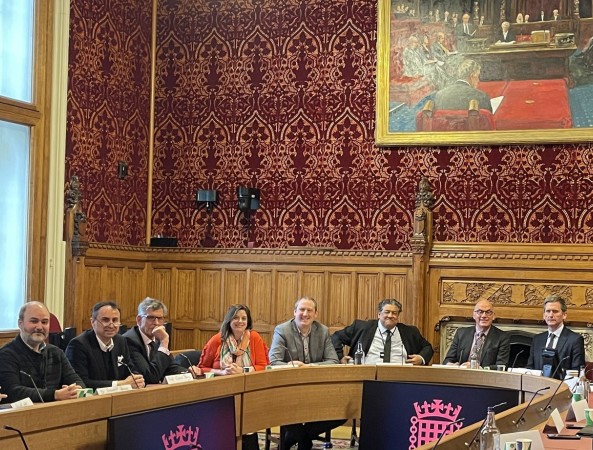
DECaDE has done so through oral evidence to House of Lords Select Committees, written submissions to government consultations, and direct engagement with All-Party Parliamentary Groups (APPGs) and government departments – notably DCMS, DSIT, HMRC, and the Cabinet Office. We contributed evidence to the regulation of crypto-assets in the aftermath of NFTs; to the role of distributed ledger technologies in reducing friction in cross-border trade following Brexit; and to data governance surrounding the rise of generative AI, including online harms and the debate on copyright and opt-out for AI training.Our evidence informed parliamentary debate in England and Scotland, supporting digital property reform while redefining what it means to ‘own’ a digital asset.”
Research Highlights

Shaping the Future of Digital Assets
DECaDE researchers explore how legal frameworks can support ownership and rights in an increasingly decentralised digital economy. As governments develop legislation for digital assets, the research examines how property law can evolve to protect creators, support innovation and enable trusted digital exchange.
Through legal analysis, industry workshops and policy engagement, DECaDE contributes evidence to legislative discussions on digital assets in the UK. Drawing on insights from projects such as ORAgen, the research explores public attitudes towards digital ownership, media tokenisation and rights management.
The findings inform policy recommendations that support a more flexible and inclusive approach to digital asset ownership, helping shape the future legal framework for the digital economy.
Team: Burkhard Schafer, Chris Elsden, Frances Liddell, John Collomosse and collaborators.
Making AI Training Fair
DECaDE researchers help shape policy on copyright and AI by exploring how media provenance can support fair, transparent and accountable AI training. As generative AI increasingly relies on creative content, the research examines how creators can retain greater control over how their work is used while enabling responsible innovation.
Drawing on technologies and frameworks developed through DECaDE, including ContentARCs, ORA, DECORAIT, EKILA and ORAGen, the research demonstrates how provenance standards can support consent, licensing and compensation for AI training at scale. Rather than framing the debate as a choice between opt-in and opt-out, DECaDE proposes practical technical solutions that enable creators to communicate their preferences in a transparent, machine-readable way.
This work informs the UK Government’s policy discussions on copyright and AI through the Time to ACCCT report, parliamentary evidence, and participation in government and industry working groups, helping shape the future of responsible AI.

Tackling Online Harms
DECaDE researchers are helping shape national and international approaches to tackling online misinformation and disinformation. Through advances in media provenance, the research provides new ways to increase transparency around digital content and support more informed trust decisions.
DECaDE has contributed to government and industry efforts to address online harms, including embedding researchers within the Department for Science, Innovation and Technology (DSIT) to provide expertise on media provenance and digital trust. The team’s research has also informed the development of the C2PA international standard, helping establish trusted approaches to communicating the origins and history of digital media.
DECaDE’s work has informed policy and technical discussions across the UK and internationally, including contributions to reports for Ofcom, the Home Office and DCMS, as well as expert advice to organisations including DARPA, the US National Academy of Sciences and the Royal Society. Together, this work is helping shape future approaches to tackling online harms and strengthening trust in digital media.