
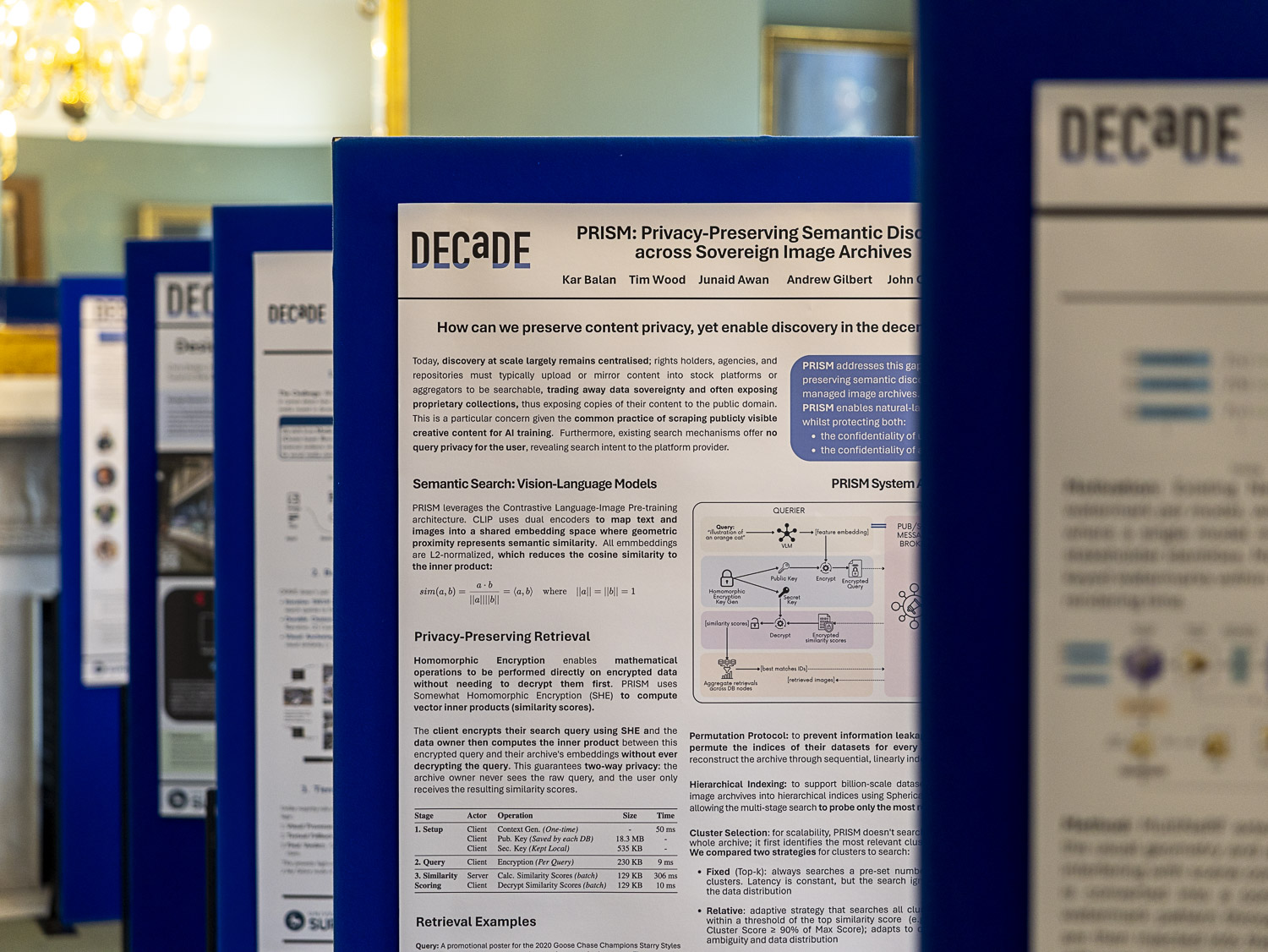
 A central theme throughout DECaDE’s research has been provenance – the ability to verify the origin, ownership, and history of digital and physical assets. Whether supporting media authenticity, enabling transparent AI training data reuse or improving trust in global supply chains, provenance provides the foundation for more trustworthy digital ecosystems.
Over six years, DECaDE has demonstrated that decentralisation is not simply a technological challenge but a social, legal and economic one. Building systems that people trust requires more than innovation alone; it demands open standards, transparent governance and mechanisms that ensure accountability from the outset.
The ideas, technologies and policy frameworks developed through DECaDE provide important foundations for a digital economy in which creators retain agency, markets operate transparently and trust can be maintained as technology continues to evolve. As debates around AI, digital identity, provenance, and trusted data continue to grow, the centre’s research offers valuable foundations for future innovation, collaboration and real-world impact.
The future of decentralisation will depend not only on what we build, but on how we choose to govern, sustain and apply these technologies. Through its interdisciplinary approach and close collaboration with industry, policymakers and communities, DECaDE has helped shape this conversation and laid the groundwork for the next generation of trusted digital systems.
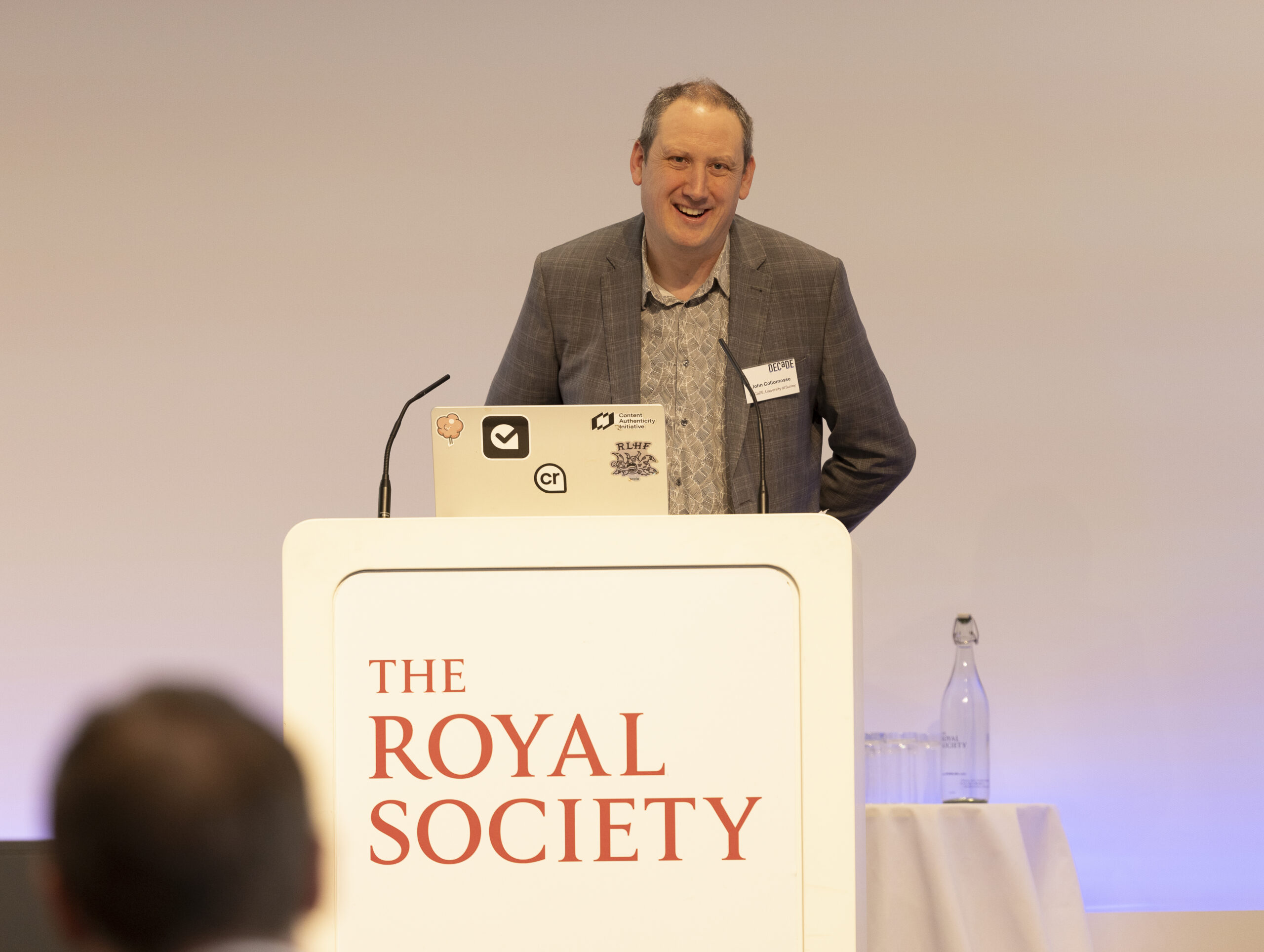
What comes next? In our final Q&A, DECaDE Director Professor John Collomosse reflects on the centre’s achievements and explores the future opportunities, collaborations and research directions emerging from its work.
Looking back over the past six years, what do you consider DECaDE’s most significant achievements?
DECaDE’s most significant achievement has been the supply-chain framing it brought to the study of our future digital economy. Whether looking at creative content, AI training data, online information, digital assets or physical goods represented through digital twins, the same underlying questions recur: where did something come from, how has it changed, who has rights in it, and how can value be exchanged fairly? DECaDE showed that digital provenance is a design pattern that recurs across sectors as diverse as wine trading and the creative industries, providing a practical foundation for answering those questions.
Just as importantly, DECaDE demonstrated how this kind of research needs to be done. The centre brought together computer science, economics, law, business, design, policy and creative practice, and worked closely with industry, policymakers and communities. That interdisciplinary model allowed research ideas to mature into prototypes, standards contributions, policy evidence, playbooks and real-world collaborations.
So I would say DECaDE’s biggest achievement is not a single project or technology, but the creation of a coherent research agenda and community around trusted digital supply chains. It has helped establish the foundations for a future digital economy in which decentralisation supports agency, transparency, accountability and fair value exchange.
Many of DECaDE’s projects explored the role of trust in digital systems. Why is trust such an important challenge for the future digital economy?
The digital economy is increasingly a decentralised, peer-to-peer economy in which individuals and organisations are both producers and consumers of digital goods and services. Take the creative sector, and news in particular. We no longer receive content primarily from a small number of established broadcasters; it reaches us through podcasts, social platforms, independent creators and increasingly AI-mediated channels. This creates greater participation and diversity, but it also weakens the role of institutional reputation as a basis for trust.
Similar patterns arise in online reputation, where reviews, ratings and recommendations influence economic decisions but may be manipulated or difficult to verify. They also recur in digital supply chains, where organisations need reliable information about the origin, movement and rights associated with data and assets across institutional and national boundaries.
DECaDE recognised from the outset the need for new forms of digital infrastructure to underpin trust in this decentralised economy. That includes technical mechanisms such as provenance, interoperable standards and decentralised platforms that make origins and histories visible, and allow trust information to move between systems. But it also includes the legal and social aspects of that infrastructure: governance frameworks that define responsibilities, and legal mechanisms that provide accountability and redress. Studying this challenge through exactly this multidisciplinary lens has been DECaDE’s focus and has underpinned its research contributions.
How have developments in generative AI changed the context for DECaDE’s research since the centre began in 2020?
The technology landscape has changed enormously since DECaDE began in 2020. At that time, concerns around centralised data silos and governance were still freshly shaped by the Cambridge Analytica scandal of 2018. Non-Fungible Tokens, or NFTs, were emerging as a novel decentralised mechanism for asserting ownership and provenance over data, particularly creative content. The rapid digital shift during the COVID-19 pandemic accelerated interest in NFTs, while public awareness of related decentralised technologies, including cryptocurrencies, also became mainstream.
DECaDE began by asking how the provenance of data could be established using decentralised technologies, whether for digital assets in the content supply chain or digital twins of physical supply chains, and how this might support improved governance, agency and value exchange. Generative AI was not yet mainstream, but its precursors were already visible. Generative adversarial networks, or GANs, were producing increasingly realistic images, synthetic portraits and cloned voices, raising public concern about deepfakes, misinformation and the misuse of personal likeness.
In that sense, DECaDE launched at the intersection of two concerns: how individuals and organisations could retain agency over data and creative assets, and how trust could be maintained in a decentralised information environment where fake news and manipulated media were becoming harder to detect. Even before generative AI became mainstream through systems such as DALL-E, DECaDE was exploring the use of media provenance and decentralised registries, building on earlier UKRI-funded work such as ARCHANGEL. It also examined adoption questions around emerging decentralised data markets, including NFTs, through early projects such as ‘A Token Gesture’.
The rise of generative AI therefore did not change DECaDE’s core questions so much as make them more urgent, due to the scale and breadth of data reuse. Creative works, digital media, datasets and other digital assets can now be ingested and repurposed at unprecedented speed and scale. This has brought issues such as copyright and AI, transparency in training data, attribution, consent, compensation and content authenticity to the centre of public and policy debate.
In many ways, generative AI has validated the importance of DECaDE’s original research agenda. Provenance and decentralised trust are becoming essential foundations for a future digital economy that depends on transparency, accountability and fair value exchange in the use of data and digital assets.
Which research outcomes or technologies developed through DECaDE do you believe have the greatest potential for real-world impact?
One clear example is DECaDE’s work on content authenticity and provenance. This research helped shape practical approaches for allowing digital media to carry information about its origin, history and transformations, and influenced wider industry activity around the C2PA international standard and the Content Authenticity Initiative. Some ideas developed through DECaDE and earlier UKRI Digital Economy projects such as ARCHANGEL are now reflected in real-world standards and workflows used by creators.
A second area is rights-aware infrastructure for the age of generative AI. DECaDE explored how provenance, decentralised registries and machine-readable rights information can help creators and rights holders express how their work may be used, reused or licensed. This work includes not only technical frameworks (ORA and ContentARCs) but also studies into their applicability and value in creative practice (ORAgen and ORAgen Fables). Partnering with the CoSTAR National Lab on the ‘Time to ACCCT’ report helped translate this research into policy recommendations around attribution, consent, control and compensation, and support DECaDE’s wider engagement with government on these issues.
The Reduced Friction for International Trade (RFIT) project led by DECaDE researchers examined how decentralised technologies can support more transparent, auditable and accountable information flows across physical supply chains, especially in cross-border trade. Working closely with the UK Cabinet Office, this created policy impact in areas such as the Electronic Trade Documents Act. Related work on digital assets such as our responses to consultations on crypto-asset regulation also helped inform debates about how digital objects should be understood, owned and governed.
Finally, at a meta level, DECaDE’s methodological insights into interdisciplinary working around decentralised technologies will have lasting impact, both through the researchers we trained and through the Decentralised Service Design Playbook, which generalises design patterns and lessons from DECaDE across sectors beyond those we had time to explore.
What are the biggest challenges that still need to be addressed as decentralised technologies continue to evolve?
A major challenge is adoption. Many decentralised technologies are technically promising, but real impact depends on whether people and organisations are willing and able to use them. DECaDE’s research showed that adoption is shaped not only by the technology itself, but by organisational readiness, business value, governance, leadership, privacy expectations, standards and wider ecosystem incentives.
One of the deeper challenges is what DECaDE described as blockchain’s paradox. Decentralised technologies promise transparency, immutability and reduced dependence on central intermediaries, yet real-world deployment often requires governance, control, accountability and sometimes confidentiality. In supply chains, for example, organisations may want shared provenance and traceability, while still needing to protect commercially sensitive information and manage liability. These tensions are not simple either/or choices; they require careful, context-specific balancing.
A second challenge is ensuring that decentralisation does not simply move power from one place to another. Systems can be technically decentralised while still becoming economically, socially or infrastructurally concentrated. Smaller firms may depend on standards, protocols and platforms they did not shape. That means we need to keep asking who controls the rules, who benefits, who is accountable when things go wrong, and how disputes are resolved. This also raises important regulatory challenges, because decentralised systems often cross borders and institutional boundaries, making legal accountability complex.
Finally, these systems must be environmentally sustainable if they are to become part of long-term digital infrastructure. Decentralised technologies such as blockchain have come a long way, particularly with the move away from energy-intensive mining towards proof-of-stake systems, but sustainability remains an important design constraint.
Looking ahead, what opportunities do you see for building on DECaDE’s research and creating new collaborations?
DECaDE’s funding wraps up this year, and there are fewer opportunities for programme-scale funding of deeply cross-disciplinary centres of the kind supported by the former UKRI Digital Economy programme. One of the visionary aspects of that programme was that it cut across research councils and created space for research that did not fit neatly into a single disciplinary box. Yet that kind of space remains very important for socio-technical challenges such as decentralised systems, AI, data privacy and trust.
DECaDE’s work will continue through targeted funded projects and collaborations tackling crucial open questions that emerged through the programme. Two AHRC BRAID projects will carry forward our work on responsible AI, governance and creative-sector engagement, particularly around media provenance and authenticity. Our collaboration with the CoSTAR National Lab will continue to develop the link between provenance, copyright, AI and the creative industries. For example, the follow-on P3R project will explore extensions of provenance to issues of personality rights and likeness. Several DECaDE researchers have also applied for, or been successful in securing, fellowships to pursue further aspects of the centre’s work.
More generally, DECaDE has been about digital supply chains: how we determine the provenance of data, digital assets and physical goods, whether in creative industries and media, where provenance can support both authenticity and fair value exchange, or in digital twins of physical supply chains. Many sectors now face the same basic question: how do we know where data, content or products came from, how they have been used or transformed, and whether they can be trusted?
That creates strong opportunities for new collaborations. In AI, provenance can help address data transparency, training-data governance, poisoning, copyright and fair trade in data. In global supply chains, similar ideas can support accountability around origin, compliance, sustainability and even issues such as modern slavery. The opportunity now is to take the methods, technologies and partnerships developed through DECaDE and apply them to these next-generation digital supply-chain challenges.
What has been your own personal highlight working within the centre?
My personal highlight has been enabling people from very different disciplines to come together around a shared set of problems. DECaDE brought computer scientists, economists, lawyers, business modellers, designers, policymakers and creative practitioners into the same conversation. That was not always easy, but it was precisely what made the centre valuable. It was also essential when tackling a deeply socio-technical challenge such as decentralised platforms, where the central questions are not only about technology, but about how people interact, define value, exchange value and build trust.
I have particularly enjoyed seeing research ideas mature into policy contributions, standards, and in some cases even commercial products with our industry partners. One of DECaDE’s missions from the outset was to move decentralised technologies beyond the lab workbench, using our industry partnerships and the Digital Catapult field labs to deploy them in real-world settings. That not only delivers impact, but also allows us to uncover and study the deeper, and arguably more interesting, socio-technical questions around adoption, governance and sustainability. Many of those deployed prototypes and insights went on to make tangible impacts in industry practice and policy on difficult topics such as online harms, content authenticity and copyright in the age of AI.
The people have also been a highlight. DECaDE created a generous and intellectually curious community, and it has been a privilege to work with colleagues, partners and students who were willing to tackle difficult questions from many different angles.
What excites you most about the future of the digital economy?
What excites me most is the opportunity to rethink how power, data and value are organised online. Over the past two decades, much of the digital economy has become concentrated around a relatively small number of powerful platforms that control data, infrastructure and access to markets. That concentration has enabled enormous innovation, but it also raises major societal questions around agency, privacy and fair value exchange.
Decentralised platforms are still maturing, but DECaDE has shown across several sectors that they offer a viable route to addressing some of these challenges. From creative content markets to cross-border trade, future digital supply chains will require infrastructure that balances efficiency with integrity, without relying on a single centralised point of trust. At the heart of this transformation lies provenance: the ability to establish trusted data, verify origin, and trace the lifecycle of digital and physical assets alike.
Whether safeguarding media authenticity, enabling transparent AI training data reuse, or tracking goods across borders, DECaDE has demonstrated that provenance can provide the connective tissue between actors in the digital supply chain. I remain excited about the transformative impact that decentralised ways of establishing provenance could deliver across sectors we have not yet begun to explore.
Although the DECaDE programme now concludes after six years, the challenges it has addressed are only beginning to scale. The ideas, technologies and policy frameworks developed through DECaDE provide foundations for a digital economy in which creators retain agency, markets operate transparently, and trust can endure even as technology accelerates. Delivering that future will require the kind of deeply multidisciplinary collaboration exemplified by the UKRI Digital Economy programme, and embodied by the next generation of socio-technical researchers trained through translational centres such as DECaDE.