

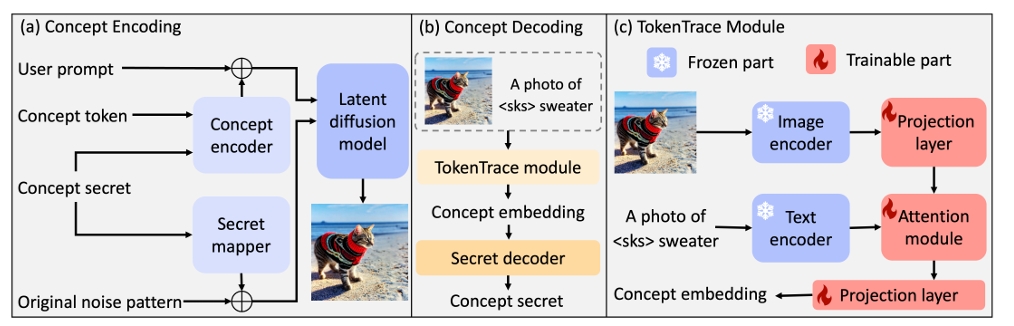
Among the highlights to be presented is TokenTrace: Multi-Concept Attribution through Watermarked Token Recovery, a CVPR 2026 paper developed through a collaboration between researchers at DECaDE and Adobe Research. The work explores a central challenge in generative AI: When an AI-generated image blends multiple visual concepts, styles and influences, how can those individual contributions be traced?
This line of research is closely aligned with DECaDE’s work on decentralised creative economies and the future of rights-aware digital content supply chains. As generative AI becomes more deeply embedded in media production, new technical infrastructure will be needed to support transparency, consent, attribution and fair value exchange. Provenance standards such as C2PA can document the history and authenticity of media assets, while attribution methods such as TokenTrace explore how creative influence flows through AI training and generation itself. [5]
TokenTrace builds on a series of research projects exploring how provenance and attribution technologies can make generative AI systems more transparent. At CVPR 2023, DECaDE introduced EKILA and the ORA (Ownership Rights Attribution) framework — the first end-to-end system for tracing and compensating creators for their contributions to generative AI training, using visual fingerprinting to match generated images to influential training examples. [2]
Subsequent research moved towards more causative forms of visual attribution. ProMark, presented at CVPR 2024, and CustomMark, presented at ICCV 2025, explored how invisible watermarking of training data can allow attribution signals to persist through the generative process. [3,4]. TokenTrace extends this trajectory by addressing compositional attribution: the problem of recovering multiple interacting influences within a single generated output, rather than identifying only one dominant source. [1]
Also at CVPR, DECaDE Director Professor John Collomosse will co-chair the Authenticity and Provenance in the Age of Generative AI (APAI) workshop, which brings together researchers and practitioners working on provenance, synthetic media detection and AI transparency. At APAI, DECaDE will also present PRISM: Privacy-Preserving Semantic Discovery Across Sovereign Image Archives, first authored by DECaDE PhD student Kar Balan. PRISM [6] explores how creators and archives can make visual content discoverable for licensing and AI use while retaining control over their data.
Professor Collomosse will also deliver a keynote at the SPAR-3D workshop, connecting provenance research to emerging questions around 3D content, generative media and trustworthy digital production.
These contributions reflect DECaDE’s wider research agenda: developing provenance as digital infrastructure for the creative economy through trustworthy content supply chains that support greater creator agency and compensation for the re-use of their work.
References
[1] L. Zhang, S. Agarwal, J. Collomosse, P. Xie, and V. Asnani, “TokenTrace: Multi-Concept Attribution through Watermarked Token Recovery,” Proc. IEEE/CVF Conference on Computer Vision and Pattern Recognition (CVPR), 2026.
[2] K. Balan, S. Agarwal, S. Jenni, A. Parsons, A. Gilbert, and J. Collomosse, “EKILA: Synthetic Media Provenance and Attribution for Generative Art,” Proc. IEEE/CVF Conference on Computer Vision and Pattern Recognition Workshops (CVPRW), 2023.
[3] V. Asnani, J. Collomosse, T. Bui, X. Liu, and S. Agarwal, “ProMark: Proactive Diffusion Watermarking for Causal Attribution,” Proc. IEEE/CVF Conference on Computer Vision and Pattern Recognition (CVPR), 2024.
[4] V. Asnani, J. Collomosse, X. Liu, and S. Agarwal, “CustomMark: Customization of Diffusion Models for Proactive Attribution,” Proc. IEEE/CVF International Conference on Computer Vision Workshops (ICCVW), 2025.
[5] J. Collomosse and A. Parsons, “To Authenticity, and Beyond! Building Safe and Fair Generative AI Upon the Three Pillars of Provenance,” IEEE Computer Graphics and Applications, vol. 44, no. 3, pp. 82–90, 2024.
[6] K. Balan, T. Wood, M. Awan, A. Gilbert, J. Collomosse., “PRISM: Privacy-Preserving Semantic Discovery Across Sovereign Image Archives,” CVPR Workshop on Authenticity and Provenance in the Age of Generative AI (APAI), 2026