
Opening the Doors to ORAgen

On 29th September, researchers from The Centre for the Decentralised Digital Economy (DECaDE) presented ‘ORAgen Fables’, a pilot of their latest ‘ORAgen’ research project.

On 29th September, researchers from The Centre for the Decentralised Digital Economy (DECaDE) presented ‘ORAgen Fables’, a pilot of their latest ‘ORAgen’ research project. This was part of ‘Doors Open Day‘ in Edinburgh, which included public tours around the Informatics building, Bayes Centre, and Inspace Gallery at University of Edinburgh.

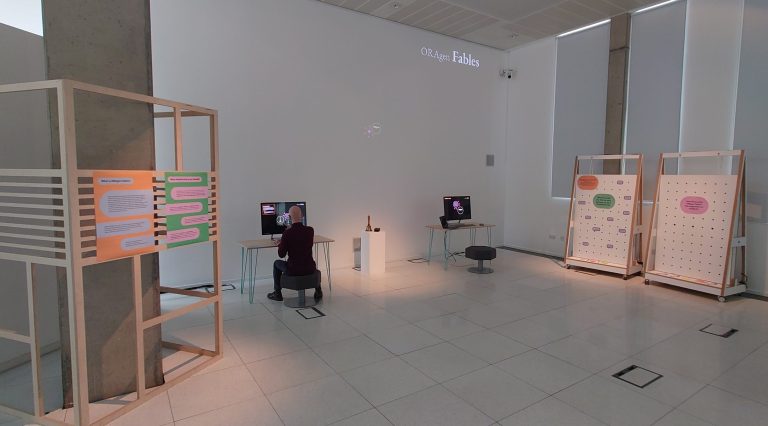
ORAgen is a new attribution and rights management tool developed by DECaDE researchers to probe public understanding and reception to the concept of media tokenisation and rights. ‘ORAgen Fables’ a pilot of the technology, is an interactive demonstrator that explores the value of provenance data through collaborative story writing. Visitors at the Inspace Gallery were invited to add and build upon each other’s contributions to create a backstory about an object. Along with two other research projects from Institute for Design Informatics, ORAgen Fables was presented to understand how audiences engaged with the new version and for their feedback to develop the demonstrator.

Dr. Frances Liddell, DECaDE researcher based the University of Edinburgh commented, “Doors Open Day was a brilliant opportunity for us to test out ORAgen Fables and to see how the public engaged with it. We are looking forward to using what we have learned in the development of ORAgen Fables in preparation for future events and exhibits.”

The Centre for the Decentralised Digital Economy (DECaDE) is a five-year EPSRC funded Next Stage Digital Economy Centre, part of the Centre for Vision, Speech and Signal Processing exploring how data-centric technologies, such as Distributed Ledger Technology (DLT) and artificial Intelligence (AI) could transform our future digital economy through decentralised platforms.

If you would like to learn more about ORAgen Fables or have a venue we could showcase this interactive part of our research, then please contact Dr. Frances Liddell – fliddell@ed.ac.uk

Add Your Heading Text Here

Related Articles

Q&A

The Next DECaDE

Over the past six years, DECaDE has tackled some of the digital economy's biggest challenges. As generative AI, digital trade and global supply chains evolve, trusted systems that enable transparency, accountability and fair value exchange are becoming increasingly important. In our final Q&A, DECaDE Director Professor John Collomosse reflects on the centre's achievements and discusses the future opportunities, collaborations and research directions it has inspired.

DECaDE Research Recognised at CVPR 2026 with Compute Transparency Award

Researchers from DECaDE, part of the Centre for Vision, Speech and Signal Processing (CVSSP) at the University of Surrey, received international recognition at the IEEE/CVF Conference on Computer Vision and Pattern Recognition (CVPR) 2026 when their paper, TokenTrace, was awarded the CVPR Compute Transparency Champion Award.
News

DECaDE Showcases Provenance and Attribution Research at CVPR 2026 

DECaDE will have a significant presence at CVPR 2026, one of the world’s leading conferences for computer vision and AI, with contributions spanning synthetic media provenance, watermarking, attribution and trustworthy generative AI. CVPR takes place from 3–7 June 2026 in Denver, Colorado. 

On 29th September, researchers from The Centre for the Decentralised Digital Economy (DECaDE) presented ‘ORAgen Fables’, a pilot of their latest ‘ORAgen’ research project. This was part of ‘Doors Open Day‘ in Edinburgh, which included public tours around the Informatics building, Bayes Centre, and Inspace Gallery at University of Edinburgh.

ORAgen is a new attribution and rights management tool developed by DECaDE researchers to probe public understanding and reception to the concept of media tokenisation and rights. ‘ORAgen Fables’ a pilot of the technology, is an interactive demonstrator that explores the value of provenance data through collaborative story writing. Visitors at the Inspace Gallery were invited to add and build upon each other’s contributions to create a backstory about an object. Along with two other research projects from Institute for Design Informatics, ORAgen Fables was presented to understand how audiences engaged with the new version and for their feedback to develop the demonstrator.

Dr. Frances Liddell, DECaDE researcher based the University of Edinburgh commented, “Doors Open Day was a brilliant opportunity for us to test out ORAgen Fables and to see how the public engaged with it. We are looking forward to using what we have learned in the development of ORAgen Fables in preparation for future events and exhibits.”

The Centre for the Decentralised Digital Economy (DECaDE) is a five-year EPSRC funded Next Stage Digital Economy Centre, part of the Centre for Vision, Speech and Signal Processing exploring how data-centric technologies, such as Distributed Ledger Technology (DLT) and artificial Intelligence (AI) could transform our future digital economy through decentralised platforms.

If you would like to learn more about ORAgen Fables or have a venue we could showcase this interactive part of our research, then please contact Dr. Frances Liddell – fliddell@ed.ac.uk

Add Your Heading Text Here

On 29th September, researchers from The Centre for the Decentralised Digital Economy (DECaDE) presented ‘ORAgen Fables’, a pilot of their latest ‘ORAgen’ research project. This was part of ‘Doors Open Day‘ in Edinburgh, which included public tours around the Informatics building, Bayes Centre, and Inspace Gallery at University of Edinburgh.

ORAgen is a new attribution and rights management tool developed by DECaDE researchers to probe public understanding and reception to the concept of media tokenisation and rights. ‘ORAgen Fables’ a pilot of the technology, is an interactive demonstrator that explores the value of provenance data through collaborative story writing. Visitors at the Inspace Gallery were invited to add and build upon each other’s contributions to create a backstory about an object. Along with two other research projects from Institute for Design Informatics, ORAgen Fables was presented to understand how audiences engaged with the new version and for their feedback to develop the demonstrator.

Dr. Frances Liddell, DECaDE researcher based the University of Edinburgh commented, “Doors Open Day was a brilliant opportunity for us to test out ORAgen Fables and to see how the public engaged with it. We are looking forward to using what we have learned in the development of ORAgen Fables in preparation for future events and exhibits.”

The Centre for the Decentralised Digital Economy (DECaDE) is a five-year EPSRC funded Next Stage Digital Economy Centre, part of the Centre for Vision, Speech and Signal Processing exploring how data-centric technologies, such as Distributed Ledger Technology (DLT) and artificial Intelligence (AI) could transform our future digital economy through decentralised platforms.

If you would like to learn more about ORAgen Fables or have a venue we could showcase this interactive part of our research, then please contact Dr. Frances Liddell – fliddell@ed.ac.uk

Add Your Heading Text Here

On 29th September, researchers from The Centre for the Decentralised Digital Economy (DECaDE) presented ‘ORAgen Fables’, a pilot of their latest ‘ORAgen’ research project. This was part of ‘Doors Open Day‘ in Edinburgh, which included public tours around the Informatics building, Bayes Centre, and Inspace Gallery at University of Edinburgh.

ORAgen is a new attribution and rights management tool developed by DECaDE researchers to probe public understanding and reception to the concept of media tokenisation and rights. ‘ORAgen Fables’ a pilot of the technology, is an interactive demonstrator that explores the value of provenance data through collaborative story writing. Visitors at the Inspace Gallery were invited to add and build upon each other’s contributions to create a backstory about an object. Along with two other research projects from Institute for Design Informatics, ORAgen Fables was presented to understand how audiences engaged with the new version and for their feedback to develop the demonstrator.

Dr. Frances Liddell, DECaDE researcher based the University of Edinburgh commented, “Doors Open Day was a brilliant opportunity for us to test out ORAgen Fables and to see how the public engaged with it. We are looking forward to using what we have learned in the development of ORAgen Fables in preparation for future events and exhibits.”

The Centre for the Decentralised Digital Economy (DECaDE) is a five-year EPSRC funded Next Stage Digital Economy Centre, part of the Centre for Vision, Speech and Signal Processing exploring how data-centric technologies, such as Distributed Ledger Technology (DLT) and artificial Intelligence (AI) could transform our future digital economy through decentralised platforms.

If you would like to learn more about ORAgen Fables or have a venue we could showcase this interactive part of our research, then please contact Dr. Frances Liddell – fliddell@ed.ac.uk

Add Your Heading Text Here

Scroll to Top